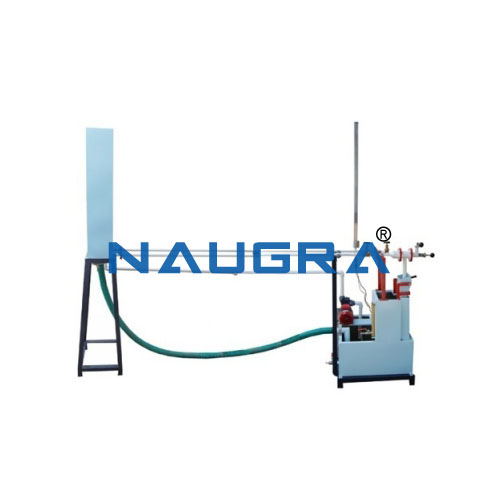
Pipe Surge and Water Hammer Test Set
Pipe Surge and Water Hammer Test Set Manufacturer India, Pipe Surge and Water Hammer Test Set Exporters, Pipe Surge and Water Hammer Test Set India Suppliers.
Specification for MOE Lab Tenders
Engineering Lab Equipment (Tender Product) Name: Pipe Surge and Water Hammer Test Set
Product Code: Fluid-Lab-0006
Product Description
Technical Specification
Should includes two separate stainless steel test pipes, both 3m long, constant head tank, slow acting valve, fast acting valve etc
A transparent surge shaft (40 mm diameter and 800mm high) with scale allows transient water levels
to be observed and timed
Electronic sensors to measure pressure transients at two locations in the water hammer test pipe, one adjacent to fast acting valve and one half way along the test pipe
Pressure transients monitored using a PC using a USB connection from the pressure transducers (requires no external electrical supply)
Straight metal pipes should be used, rather than a coiled arrangement, to minimize distortion to the pressure profile
Required Capabilities:
a. Demonstration of pipe surge resulting from slow deceleration of flow in a pipe
b. Determination of the oscillatory characteristics of a surge shaft used to attenuate pipe surge
c. Measuring the pressure profile characteristics associated with water hammer associated with rapid deceleration of flow in a pipe
d. Comparison between theoretical and measured pressure profiles associated with water hammer
e. Determination of the velocity of sound through a fluid in an elastic pipe
Should consist of two stainless steel test pipes connected to a constant head tank with the necessary connections to an Hydraulics Bench
The first test pipe should incorporates a transparent surge shaft and lever operated valve at the discharge end. An additional valve downstream should allow the flow through the test pipe to be varied before closing the lever operated valve.
A scale should be provided on the surge shaft (Pipe surge demonstrations)
pipe to be varied before closing the fast acting valve. Should allow water hammer to be generated in a relatively short length of straight pipe because of the extremely short closure time achieved using a trigger actuator. (Water hammer demonstrations)
Electronic pressure sensors should be incorporated in tappings
The transient pressure waves can be analysed on the PC(supplied) using the software
Pipe Surge and Water Hammer Test Set — Related Lab Products
Other related teaching lab equipments, scientific lab instruments and civil engineering educational lab equipments like Pipe Surge and Water Hammer Test Set.
Why Buy Pipe Surge and Water Hammer Test Set From Us
Leading Manufacturer
Direct manufacturer of Pipe Surge and Water Hammer Test Set in India — factory prices, no middlemen.
Global Export
Exporting Pipe Surge and Water Hammer Test Set to 40+ countries across Africa, Asia & the Middle East.
MOE Tender Ready
Complete documentation & specifications for Ministry of Education & institutional tenders.
Customization
Build-to-spec Pipe Surge and Water Hammer Test Set as per your curriculum & tender requirements.
Pipe Surge and Water Hammer Test Set for Education & Training
Our Pipe Surge and Water Hammer Test Set is supplied to educational institutions, technical universities, polytechnics, ITIs and industrial (vocational) training centers worldwide — engineered for hands-on, practical lab teaching and skill development.
Request a QuotePipe Surge and Water Hammer Test Set — Questions
Common questions about buying, pricing and export of Pipe Surge and Water Hammer Test Set.