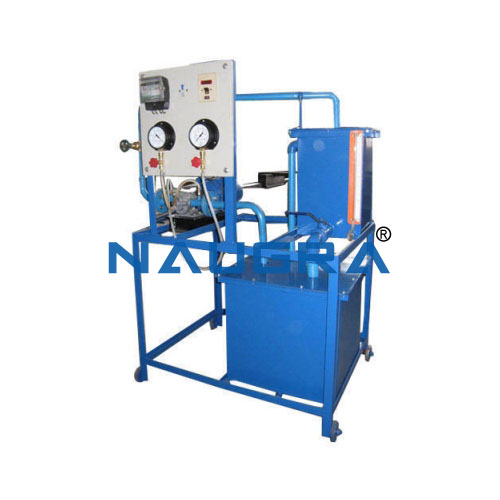
Pump Test Set
Pump Test Set Manufacturer India, Pump Test Set Exporters, Pump Test Set India Suppliers.
Specification for MOE Lab Tenders
Engineering Lab Equipment (Tender Product) Name: Pump Test Set
Product Code: Fluid-Lab-0009
Product Description
Technical Specification
The rig should accommodate both rotodynamic and positive displacement pumps, and should supply with the most common example of each type as standard (i.e. a centrifugal pump and a gear pump).
A range of other pump types should be available as accessories, (including axial, turbine, flexible impellor, diaphragm and plunger, plus a second centrifugal pump for series/parallel demonstrations).
Up to four pumps could be accommodated within the rig simultaneously for use within a single laboratory period, and each should be able to run without disconnecting any pipework or connections. Further pumps can also be interchanged straightforwardly.
As an option the unit should be able to be fitted with
two identical centrifugal pumps to allow simple series/parallel pump configurations to be demonstrated.
The equipment comprises a water reservoir, and five pump positions, (four active). Each pump position uses pipework and sensors optimised to the type of pumps it is intended for.
Each pump accessory should come on its own baseplate, assembled complete with all pipes, valves and fittings to allow it to be easily fitted
Other specifications:
a. A self contained multi-pump test rig, containing all the services and instrumentation for determining the characteristic curves of different pumps at different speeds
b. Should contains five different pump positions (4 active)
c. Centrifugal pump and gear pump should be supplied as standard.
d. Axial pump, flexible impellor pump, turbine pump, diaphragm pump, piston pump and a second centrifugal pump and all should be available as accessories e. Series/parallel pump demonstrationsshould be able to be performed with the second centrifugal pump option
f. Control valve should be incorporated upstream of each pump (except axial pump) to demonstrate the effect of suction loss on performance
g. Electronic torque measurement using a state of the art sensorless vector drive
h. Electronic measurement of flow, pressure head and suction
i. Optional volumetric flow measurement system for reciprocating pump
j. Optional data logging and educational software.
The following should be the demonstration capabilities
a. Determining the performance of different types of pumps at constant speed by producing a set of characteristic curves For rotodynamic pumps:
Pressure head v flow
Power absorbed v flow
Pump efficiency v flow For positive displacement pumps:
Flow v pressure head  Power absorbed v pressure head
Volumetric efficiency v pressure head
b. Determining the effect of speed on the performance of pumps
c. Understanding the difference between rotodynamic pumps and positive displacementpumps
d. Understanding the effect of system resistance
e. Investigating the effect of suction losses on a centrifugal pump
f. Demonstration of the effect of running two centrifugal pumps in series and parallel
g. Understanding the characteristics of a reciprocating pump
Instrumented Flow Capability
Instrumented Pressure Capability
Pump Options
300 L/min 20m Centrifugal (as standard) 300 L/min 20m - Flexible Impellor - Second Centrifugal for series/parallel operation
300 L/min 2m - Axial
75 L/min 100m - Gear (as standard)
75 L/min 100m - Turbine or - Diaphragm or - Plunger
Pump Test Set — Related Lab Products
Other related teaching lab equipments, scientific lab instruments and civil engineering educational lab equipments like Pump Test Set.
Why Buy Pump Test Set From Us
Leading Manufacturer
Direct manufacturer of Pump Test Set in India — factory prices, no middlemen.
Global Export
Exporting Pump Test Set to 40+ countries across Africa, Asia & the Middle East.
MOE Tender Ready
Complete documentation & specifications for Ministry of Education & institutional tenders.
Customization
Build-to-spec Pump Test Set as per your curriculum & tender requirements.
Pump Test Set for Education & Training
Our Pump Test Set is supplied to educational institutions, technical universities, polytechnics, ITIs and industrial (vocational) training centers worldwide — engineered for hands-on, practical lab teaching and skill development.
Request a QuotePump Test Set — Questions
Common questions about buying, pricing and export of Pump Test Set.